Eastern Bluebird · Reclaimed Wood
The Quilt Barn
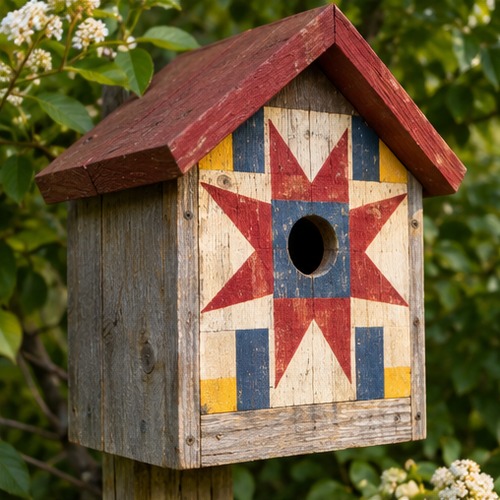
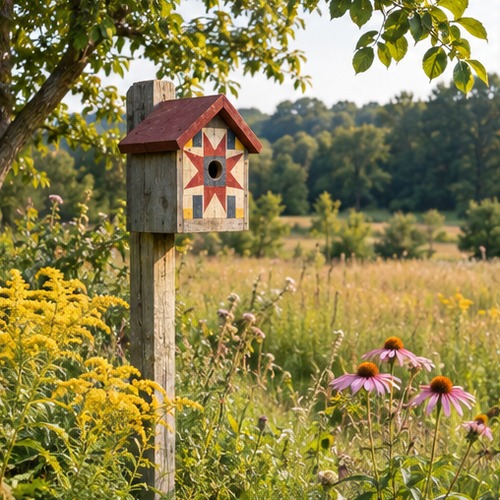
One bold block fills the front gable, borrowing the scale and geometry of a barn quilt.
The Birdhouse
The Gable Quilt
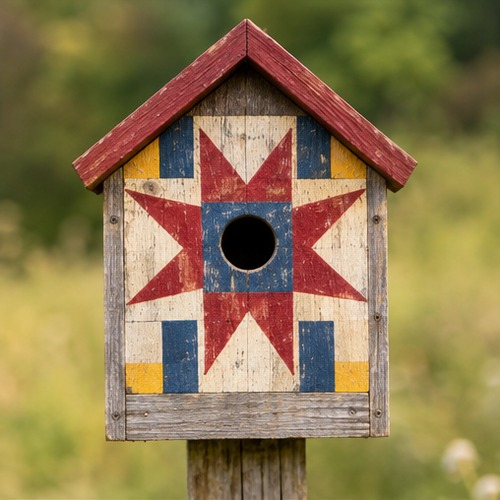
One bold block fills the front gable, borrowing the scale and geometry of a barn quilt. Large shapes keep their definition from the house or garden gate. Reclaimed grain beneath the paint gives a little variation to a design built around straight edges.
A good test for a themed birdhouse is whether you can describe it to a friend after a glance from across the yard. This one has a clear visual cue, with the finer details left for a closer look. The face of each reclaimed board varies, giving the painted surface a little of the character of the wood beneath it. Underneath that familiar outline, the form is a cavity nest box intended for the Eastern Bluebird.
The Intended Bird
Meet the Eastern Bluebird
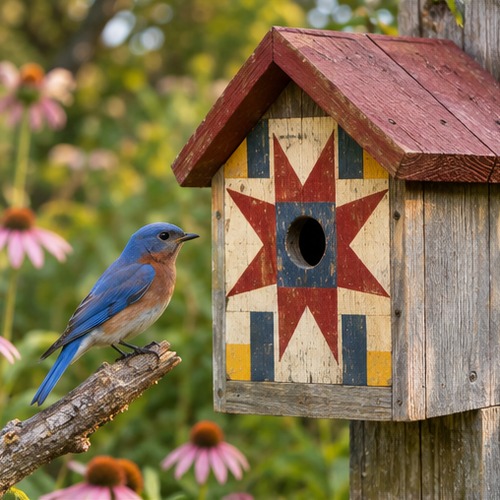
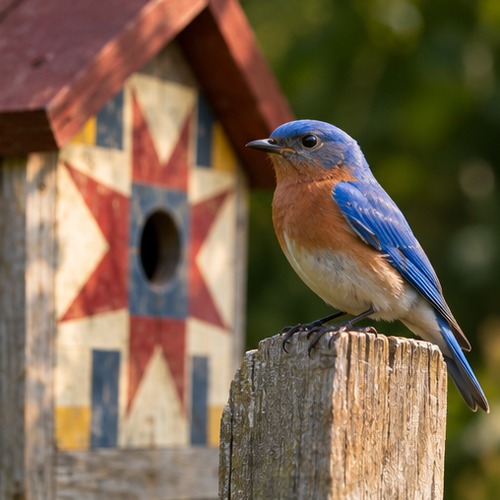
Look for blue wings above a warm rusty breast. A hunting bird often pauses on a low perch and drops straight to the ground after an insect, then returns to survey the same patch. An enclosed cavity sits beside the open ground where the pair can hunt. Bluebirds carry dry grasses into a suitable nest site and shape them into a fairly neat cup.
An adult needs to enter with nest material, turn inside and leave again with a clear flight path. That sequence explains the simple face of this design. The paint gives people something to recognize from a distance while the actual chamber gives the bird a sheltered space. When choosing a site, picture the journey from a nearby perch all the way to the opening, including the last few feet.
The Landscape
Range and Nesting Habitat
Where might you see the Eastern Bluebird? From eastern and central North America south into parts of Mexico and Central America. Many remain through winter in the southern part of the range. Look for short vegetation with scattered perches, such as an orchard edge or a lightly managed meadow. Face the opening toward a clear flight path, well away from roads and heavily treated turf.
Read the range map at two scales. First check whether your part of the country supports breeding birds. Then look at the few hundred yards around the proposed location. Local vegetation, water, elevation and neighboring land can change the answer even within one ZIP code. The linked species account is a starting point for comparing your yard with places where the bird actually nests.

The Handmade Detail
Which quilt block belongs to your family?
Select a familiar family pattern or two or three colors from a treasured quilt. A clear reference photograph helps the maker understand which shape carries the family resemblance.
For a gift, a short note explaining why you chose The Quilt Barn can be as meaningful as the house itself. Include the place, person or small memory that makes the design familiar. If you have a particular painted detail in mind, share it with the maker before ordering and ask how it will read at the finished size. Reclaimed boards have individual markings; the illustration shows the design direction, while the real piece will carry the grain of the timber selected for it.
Field Notes
Watching the House Through the Season
Use binoculars to follow the same perch for several minutes. A pair gathering grass or carrying food repeatedly in one direction is a better clue to nesting than the flash of a blue wing.
Keep a pair of binoculars at the window you use most often. Look first at the approach, then at the house, and finally at the surrounding trees or open ground. This wider view makes it easier to understand where the birds feed and which routes they prefer. It also gives a visitor a chance to inspect the house without a person waiting at the entrance. For The Quilt Barn, plan for an unobstructed view from a comfortable distance and leave the entrance quiet whenever birds are using it. Use the linked NestWatch guide to plan checks appropriate to the Eastern Bluebird.