
Purple Martin · Reclaimed Wood
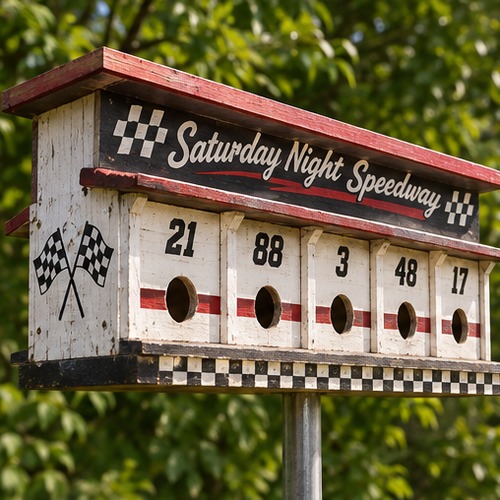
Saturday Night Speedway
A straight row of white bays turns a martin colony into pit lane.
The Birdhouse
The Pit Row
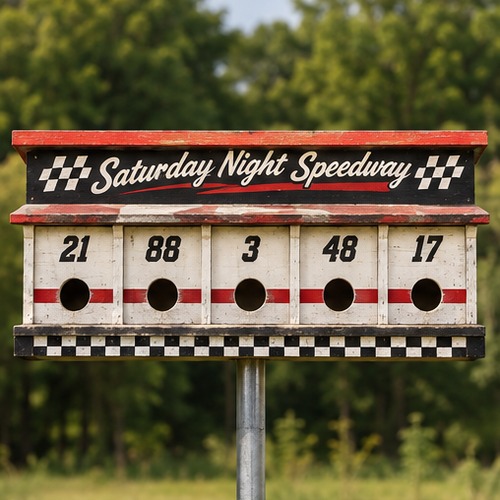
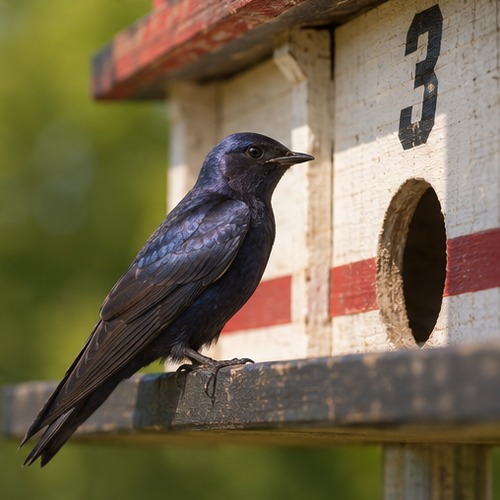
A straight row of white bays turns a martin colony into pit lane. The numerals are the boldest marks on the front, just as a driver’s number is the first thing you spot from the grandstand. A single lap board above the bays finishes the silhouette.
Imagine seeing it first from a kitchen window, then from a few steps away. At the window it is the outline you notice. Up close, the painted detail catches the eye and the grain shows why the same pattern can look a little different on each piece of reclaimed wood. Both views are part of the character of a handmade house. Underneath that familiar outline, the form is a colony house intended for the Purple Martin.
The Intended Bird
Meet the Purple Martin
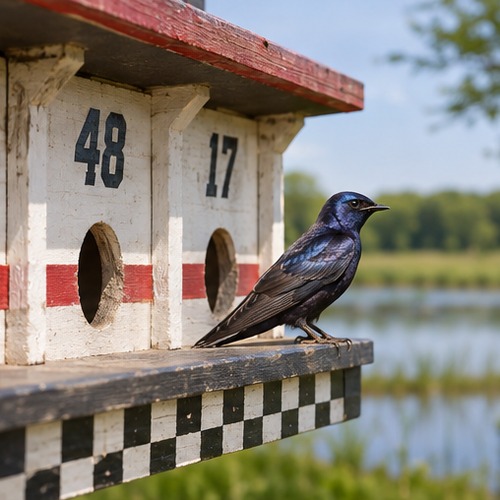
Watch above an open field or pond for long-winged swallows making broad, sweeping turns. Adult males look inky blue in good light; females and younger males show paler underparts. A colony house gives neighboring pairs separate chambers behind a shared facade. Martins often accept human-provided nesting sites in the East; western populations also use natural cavities.
The repeated bays have a purpose beyond their appearance. Each pair needs a separate chamber, while the neighboring entrances allow several pairs to settle close together. Look at the front as a row of individual doorways and then imagine the same family of swallows in flight above it. One martin can arrive while another leaves without either having to cross a neighboring nest.
The Landscape
Range and Nesting Habitat
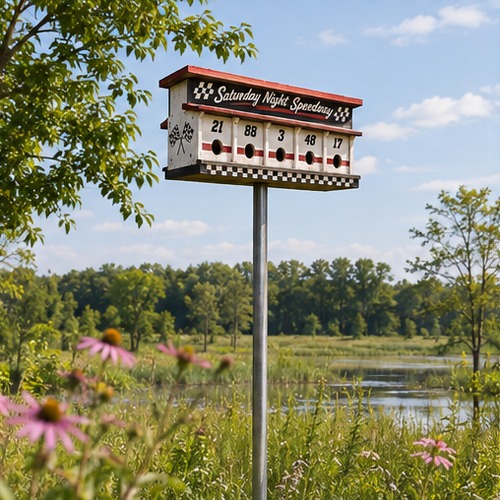
Where might you see the Purple Martin? Across much of eastern North America in the breeding season, with scattered western breeding populations and a South American winter range. An open approach on every side matters more than a picturesque tree behind the roof. Leave room for an accessible, properly supported martin pole and its lowering mechanism.
The useful question is where this bird spends its nesting season. A dot on a year-round sightings map could represent a migrant stopping for a day. Compare the breeding range with summer observations from a nearby park or natural area. Then walk your own grounds and look for the same pattern of food, cover and open approach before selecting the final spot.

The Handmade Detail
What number was on your car?
Try the number of a family race car, the first kart a child drove, or the car a grandparent followed every Saturday. Keep the digits large and leave space between them and the entrances.
When discussing Saturday Night Speedway with the workshop, describe the part of the design that first caught your eye. A quick sketch or a reference photograph can say more than a long list of changes. Think about how the piece will look in summer leaves as well as against bare branches. The grain of reclaimed wood varies from board to board, so a painted line can pick up a different texture on the finished house. Keep the entrance, the roof edge and access for seasonal care clear of any requested embellishment.
Field Notes
Watching the House Through the Season
Watch for several birds circling together, landing briefly on the roof and taking off again. Returning to one bay with nesting material tells you more than a flock passing high overhead.
Keep a pair of binoculars at the window you use most often. Look first at the approach, then at the house, and finally at the surrounding trees or open ground. This wider view makes it easier to understand where the birds feed and which routes they prefer. It also gives a visitor a chance to inspect the house without a person waiting at the entrance. For Saturday Night Speedway, plan for an unobstructed view from a comfortable distance and leave the entrance quiet whenever birds are using it. Use the linked NestWatch guide to plan checks appropriate to the Purple Martin.